
Skin and hair sit in a corner of this catalogue with relatively cleaner evidence than the muscle-growth side. Topical GHK-Cu has the longest history of cosmetic use, the strongest mechanism-of-action data, and the most consistent real-world track record. KPV is the inflammation-control adjunct for users where flares (acne, irritation, eczema-adjacent patterns) are the limiter rather than baseline tone. The hair-growth story is more qualified: there’s a real signal but the evidence is thinner than the skin- quality data, and treating GHK-Cu as a finasteride-equivalent is a misread.
This page sorts the relevant compounds by what they actually do, what the evidence supports, and where each one fits in a cosmetic protocol. Tanning sits in a separate compartment with its own application; this page focuses on skin quality, hair, and inflammation control.
The shortlist by goal
Skin quality - baseline tone, fine lines, density
- GHK-Cu topical (1–3% serum or cream). Maquart 1993 (rats), Gruchlik 2012 (in vitro fibroblast proliferation), and a series of small clinical evaluations show fine-line reduction, increased skin clarity and density. The Connectivity Map analysis (Broad Institute) is interesting: GHK-Cu reverses gene-expression signatures of aging cells toward a healthier baseline. None of this is a phase 3 wrinkle drug, but the mechanism stack and real-world cosmetic history are stronger than for most peptides on this site.
- Concentration matters. 1–2% is the standard cosmetic range. 3% is intensive. Beyond ~5%, returns flatten and irritation goes up. The carrier matters too - serum bases penetrate; thicker creams may not.
- Consistency drives results. 8–12 weeks of daily use is where most users see their first clear shift. This is not a one-week transformation product.
Inflammatory skin - acne, irritation, flare-driven texture
- KPV. The C-terminal tripeptide of alpha-MSH. Animal models (Dalmasso 2008 for colitis, Landy 2004 for psoriasis) plus in-vitro NF-κB inhibition in keratinocytes give a clean inflammation- modulation mechanism. No human cosmetic trials specifically for skin, but the mechanism is well-characterised and the community use case for inflammatory flares is consistent.
- Where it fits. Acne-driven skin where the limiter is inflammation rather than oil or hyperkeratinisation. Eczema-adjacent flares. Post-procedure redness that’s overshooting the expected window. Useful as an adjunct to GHK-Cu rather than a replacement - the two address different levers.
- Routes. Topical and oral are both used; oral systemic effect is real because the PepT1 transporter handles small peptides. Subcutaneous works for systemic inflammation profiles but isn’t the default for skin-only goals.
Hair - real signal, qualified expectations
- GHK-Cu topical to scalp. The hair-growth claim has a mechanistic basis (the same fibroblast-proliferation and hair-follicle-signalling pathways that drive skin quality also affect dermal papilla cells), and small studies plus extensive cosmetic-industry use suggest modest improvement in hair density and shaft thickness. It is not in the same evidence tier as finasteride or topical minoxidil; treating it as one is a misread.
- Honest framing. If you have androgenic alopecia and aren’t on finasteride/minoxidil, GHK-Cu alone won’t hold the line. As a stack addition on top of those drugs, the case is plausible. As a hair-quality (not density) intervention - thicker, healthier-looking shaft - the evidence is more direct.
- Protocol. Daily topical at 2–3% to scalp, ideally combined with a microneedling cadence (weekly 0.5–1 mm) which has its own minoxidil- adjacent literature and increases penetration regardless. 12–16 weeks minimum to see a fair test.
Procedure recovery - microneedling, lasers, surgical scars
- TB-500 or full-sequence Thymosin Beta-4. The standard healing-peptide pair. Useful for accelerating the inflammatory and proliferative phases of post-procedure recovery. The application case is similar to Injury Recovery - mostly systemic SC over a 4–6-week window bracketed around the procedure.
- Where it does NOT fit. As a daily anti-aging compound. The angiogenic mechanism makes routine use harder to justify than topical GHK-Cu for the same cosmetic outcome. See Cancer Risk and Growth Factors for the per-mechanism risk frame.
Pigment / tanning - covered separately
MT-II and Melanotan I sit adjacent to skin protocols but the goal (pigment shift, tanning, photoprotection) is different enough that they have their own dedicated application - Tanning. Worth noting here that any mole- darkening from MT-II protocols intersects with cosmetic priorities - baseline dermatology survey before MT-II is a sane move. The day-by-day ramp and UV-pairing rules live in the MT-II Loading Protocol guide.
Decision guide
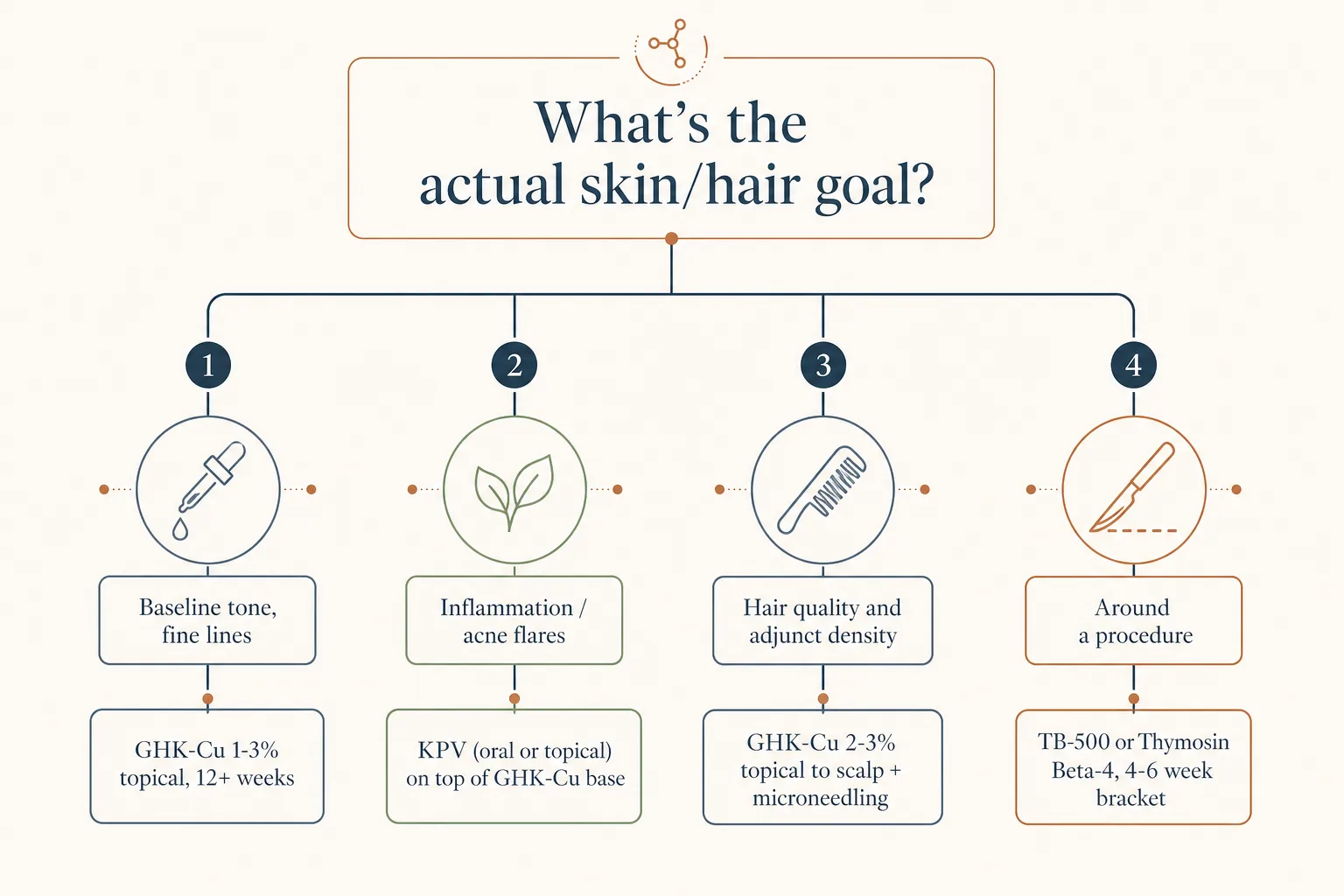
- What’s the actual goal - baseline tone, an inflammatory
flare, hair, or post-procedure healing?
→ Match the lever to the goal. Generic “peptide for skin” requests are usually really one of those four. - Is the limiter inflammation, or is it baseline texture/tone?
→ Inflammation → KPV (oral or topical) on top of a GHK-Cu base.
→ Baseline → GHK-Cu alone, given 12 weeks at 1–3% topical. - Is the user looking for hair density or hair quality?
→ Density on androgenic alopecia → finasteride/minoxidil first; GHK-Cu as adjunct, not replacement.
→ Quality / thickness / look → GHK-Cu with microneedling has the cleanest case. - Is this around a procedure (microneedling, laser, surgery)?
→ A 4–6-week TB-500 or Thymosin Beta-4 cycle bracketed around the procedure window. Default off the rest of the year. - Personal cancer history or first-degree relative with early-onset
cancer?
→ Topical GHK-Cu remains reasonable for most users (systemic exposure is minimal). Systemic SC GHK-Cu, TB-500 and Thymosin Beta-4 should be reviewed against the framework in Cancer Risk and Growth Factors.
Representative stacks
Stack 1 - The Glow Stack (baseline skin quality)
- Topical GHK-Cu 1–2% serum, applied AM and PM to clean skin, 12+ weeks minimum
- Standard supporting cast: SPF every morning (without it the gains evaporate), nightly retinoid if tolerated, no skipping the basics in favour of peptide novelty
- Optional weekly microneedling at 0.5–0.75 mm to support penetration and add a separate proliferation signal
- Photographic documentation: same lighting, same angles, week 0 / week 6 / week 12
Stack 2 - Inflammation control overlay
- Glow Stack base as above
- KPV 250–500 mcg orally twice daily, 4–8 weeks, during active flares
- Or topical 0.5–1% KPV serum during acute irritation (less common; oral is the more validated route)
- Reassess at 4 weeks - if the inflammatory phenotype resolves, taper KPV and return to the Glow Stack base
Stack 3 - Hair adjunct
- Topical GHK-Cu 2–3% serum to scalp, daily, 12–16 weeks minimum before judging effect
- Weekly microneedling 0.5–1 mm, adjusted to scalp tolerance
- If androgenic alopecia is the underlying driver: standard finasteride or minoxidil protocol underneath this. GHK-Cu is the adjunct, not the replacement
- Hair count / density photography monthly with consistent lighting and parting; subjective “does it look better” impressions are unreliable on yourself
Stack 4 - Procedure recovery
- TB-500 2–5 mg subcutaneous twice weekly, starting one week pre-procedure, ending 4–6 weeks post
- Topical GHK-Cu after the immediate post-procedure healing window closes (usually day 5–7 for microneedling, longer for ablative laser)
- Optional KPV oral during the inflammatory peak if redness is overshooting
- Cycle off entirely once the recovery window closes; this is not a continuous protocol
What stops people
- Buying low-concentration GHK-Cu. 0.05% serums exist and won’t move the needle. The published cosmetic data is on 1–2% minimum. Read the label.
- Skipping SPF. Photoaging undoes GHK-Cu’s collagen- stimulation case in months. The peptide protocol does nothing if the photodamage protocol is missing.
- Treating GHK-Cu as a hair-loss drug. It isn’t. The evidence supports adjunct use for androgenic alopecia and a real but modest case for hair quality. Setting expectations against finasteride or minoxidil is setting them too high.
- Quitting at week 4. The visible-shift timeline is 8–12 weeks at minimum for skin and 12–16 weeks for hair. People who quit at week 4 because “nothing’s happening” were always going to.
- Stacking systemic SC GHK-Cu year-round without breaks. The copper accumulation case isn’t alarming, but the standard 4–6-week cycle with a break is the conservative pattern. Continuous topical is fine; the SC framing is where the cycling rule applies.
- Underestimating placebo on yourself. Skin and hair self-assessment is one of the most placebo-prone categories there is. Photographic documentation at fixed cadence is the discipline that turns impressions into data.
Monitoring on this protocol
- Photography. Same lighting, same angles, monthly. The single most important data point. Without it, every other monitoring step underdelivers.
- Skin-quality assessment. Texture, tone, pore visibility, fine-line depth at three reference areas (forehead, crow’s feet, smile lines). Subjective but stable when the photography is.
- Hair count. Photographic count at consistent parting and angle, monthly. If serious about tracking, a TrichoScore or similar professional assessment at week 0 and week 16.
- Bloodwork (only on systemic SC). CBC and CMP at baseline plus quarterly if running systemic SC GHK-Cu, TB-500 or Thymosin Beta-4. Topical-only protocols don’t need bloodwork bracketing. See Bloodwork for Peptide Users.
- Dermatology baseline. Especially before MT-II crossover or any sustained UV-protocol stack. Photographic mole map at year zero, then annual.
Cross-references
- Anti-Aging Stack application - the broader anti-aging assembly where GHK-Cu sits as one of the load-bearing pieces alongside the GH axis and Thymosin Alpha-1.
- Cancer Risk and Growth Factors - the per-mechanism risk frame for systemic GHK-Cu and TB-500.
- Cycling Strategies - for the risk-hygiene cycle pattern on systemic healing peptides.
- Bloodwork for Peptide Users - the monitoring panel on systemic SC protocols.
- Injury Recovery application - the broader framework for TB-500 and Thymosin Beta-4 protocols.