
Why storage matters
Bad storage doesn't always announce itself. A reconstituted vial that's been warm for two days can look identical to a fresh one - same clarity, same volume - and have lost 30% of its activity to aggregation. Bad contamination is the same: the vial that infected someone's injection site doesn't look different from the one that didn't. The point of a storage protocol is to eliminate the cases where you'd otherwise have to guess.
For the per-class numbers (lyophilised long-term temps, reconstituted refrigerated days, room-temperature tolerance, travel cadences and excursion rules), see the Cold-Chain Quick Reference. For the why behind the numbers - hydrolysis vs aggregation as separate failure modes, why the Arrhenius "doubles every 10°C" rule is half-right, and the four-bucket excursion-tolerance decision frame - see Cold-Chain Reality. This article is the procedural how-to that sits underneath both.
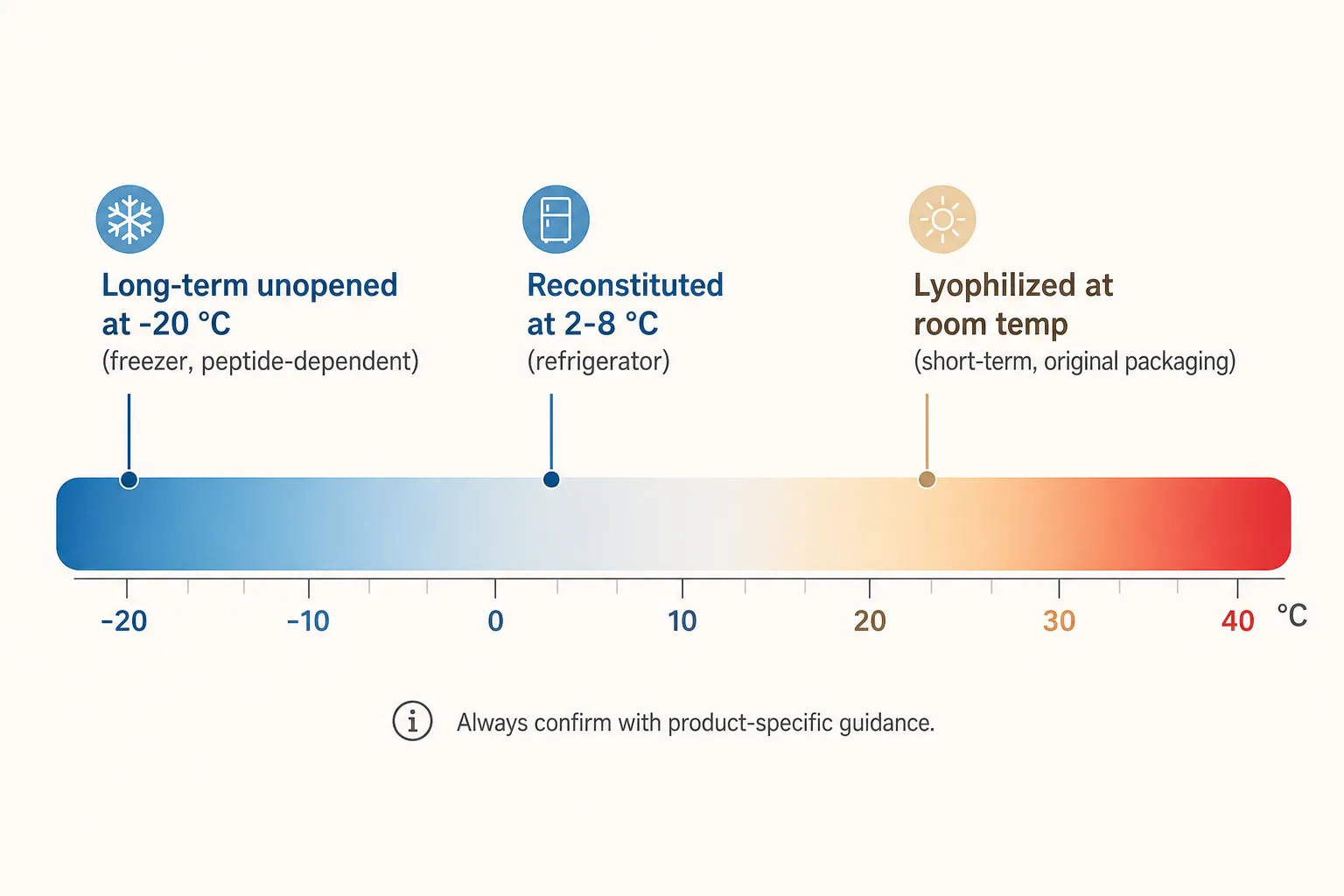
Storage by lifecycle phase
A peptide lives in three states, and the storage rules are different for each:
- Sealed lyophilised vial. Stable for months at room temperature, years frozen at −20°C. Don't refrigerate sealed lyo long-term - fridge condensation cycles can pull moisture into the vial over time. Freezer or pantry shelf, depending on time horizon.
- Reconstituted vial in active use. 2–8°C refrigerated, typically a 28–30 day window. The benzyl-alcohol preservative in BAC water is what buys this window; without it, drop to days.
- Late-vial (last 1/3). Same temperature rules, but aggregation has accumulated. Invert and gently swirl before each draw - aggregates settle at the bottom and you'll otherwise pull a more-aggregate fraction at the end of the vial than at the beginning.
Temperature control basics
- Use a real fridge with a stable thermostat. A bar fridge or a wine cooler set to 4°C works. Mini-fridges with poorly-tuned thermostats can dip below freezing in the back; if that happens once, the vial is potentially aggregation-damaged regardless of how it looks.
- Door shelf or front of the main shelf, not the back wall. Some older fridges run colder at the back. The door shelf is slightly warmer but more thermally stable across cycling.
- Freezer at −20°C, not the ice-cube compartment. Standard kitchen freezers are typically −18 to −20°C. The ice-cube compartment of a fridge-freezer combo can run warmer and more variable.
- Avoid repeated warm/cold cycling. The aggregation contribution from freeze-thaw is dramatic. Aliquot-and-freeze-once if you must split a vial; never refreeze a thawed reconstituted vial.
- Don't assume class-uniform stability. IGF-1 LR3 is more fragile than BPC-157 by a wide margin, and a reconstituted GLP-1 pen has a manufacturer-specified excursion window that grey-market vials don't inherit. Per-compound rules win over generic ones.
Light and moisture protection
- Light-sensitive compounds: original packaging. Melanocortin peptides (Melanotan II, PT-141), Selank and Semax intranasal sprays, and several others are photolabile. The factory carton or an opaque storage box does the job; the fridge interior light is brief enough to not matter in normal use.
- Don't store vials on the door of a glass-front fridge. Constant ambient light through the door, especially with a sunlit kitchen, is meaningful exposure for photolabile compounds.
- Moisture intrusion through punctured stoppers. Each puncture is a one-way valve that closes imperfectly. Repeated puncture + high-humidity environment + repeated thermal cycling can pull water vapour into the headspace over weeks. Coring (rubber particles in solution) is the more visible failure of the same mechanism.
- Cap stoppers between draws. If your vial came with a flip-cap, leave it flipped on between uses. Tiny barrier; meaningful over a 30-day vial life.
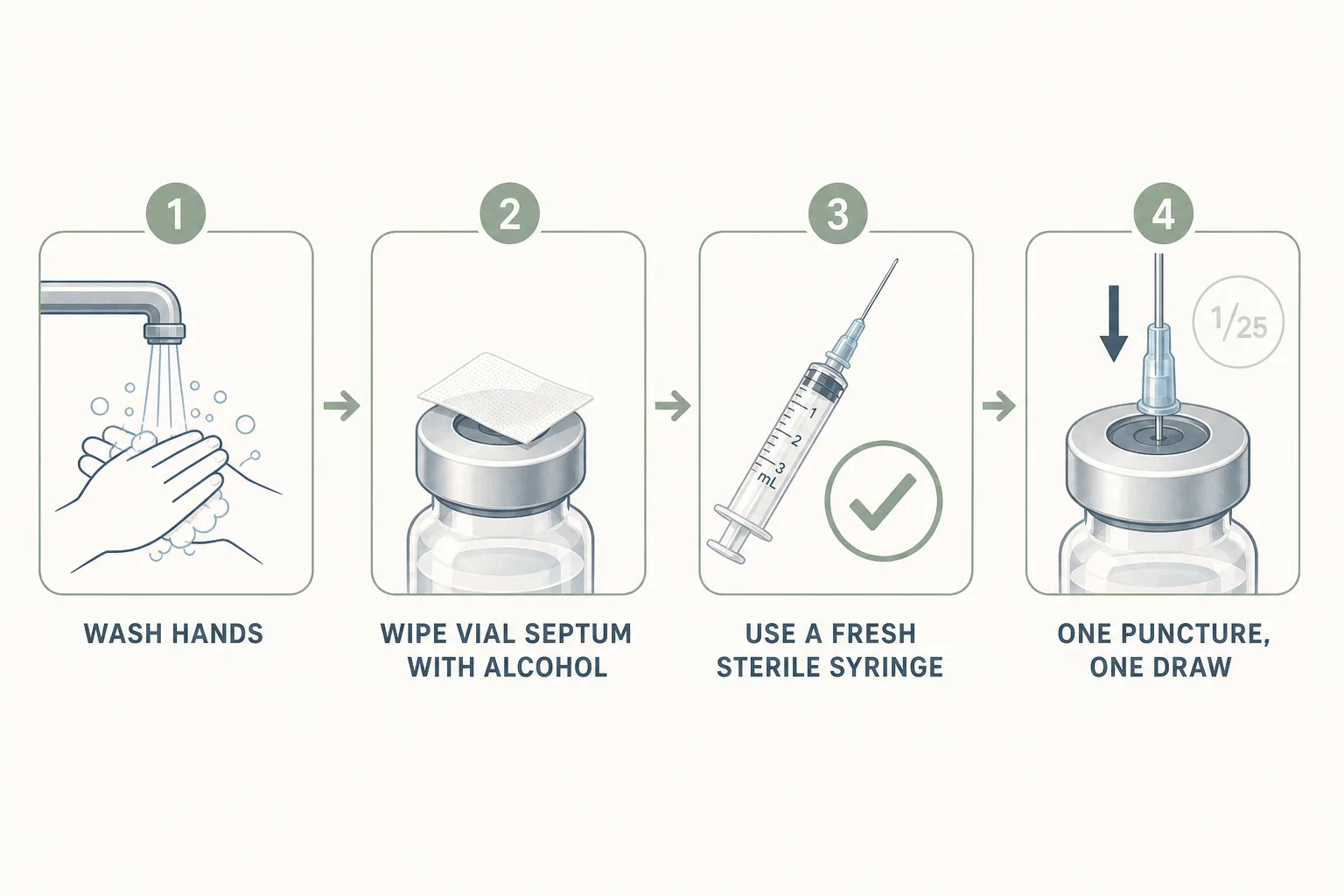
Contamination prevention during handling
- Wash hands before any vial access. Soap and water for 20 seconds beats hand sanitiser for actually removing skin flora; the sanitiser is the topping, not the base.
- Wipe the septum with 70% isopropyl alcohol, let it air-dry. 70% IPA is the standard - it's more effective than 90%+ at protein denaturation because the water content lets the alcohol penetrate bacteria. Contact time matters: wet the swab, wipe with light pressure, let it evaporate (10–15 seconds). Don't blow on it or wipe it dry.
- Use a fresh sterile syringe for each draw. Reusing a syringe between vials cross-contaminates regardless of intermediate cleaning. Syringes are cheap; the failure mode (introducing organisms into a long-life vial) is not.
- Minimise punctures. Each puncture cores the rubber stopper slightly, generates particles, and creates a microleak. A vial drawn 4 times is structurally different from a vial drawn 40 times even at the same calendar age.
- Keep the work surface clean. A clean dry plate or a paper towel on a wiped countertop. Don't lay the syringe needle-down on skin or fabric between steps.
Labeling and tracking
- Reconstitution date on the vial. Permanent marker on the side of the vial, not the cap. Date format that survives smudge: YYYY-MM-DD or "DD/MM" with year on the box.
- Concentration too. "10 mcg/u" or "5 mg/2 mL" - whatever matches how you draw. Future-you will not remember which vial got reconstituted in which volume.
- Lot / source. Keep the box or a written log of vendor + lot. If a problem appears (counterfeit, contamination, response failure), the lot ID is what lets you assess scope.
- Discard criteria, written down once. Cloudiness, particulates, colour change (yellow / brown), past use-by date, frozen accidentally (for non-pen vials, thaw and inspect; for pens, discard outright). Don't try to evaluate these criteria from memory mid-protocol.
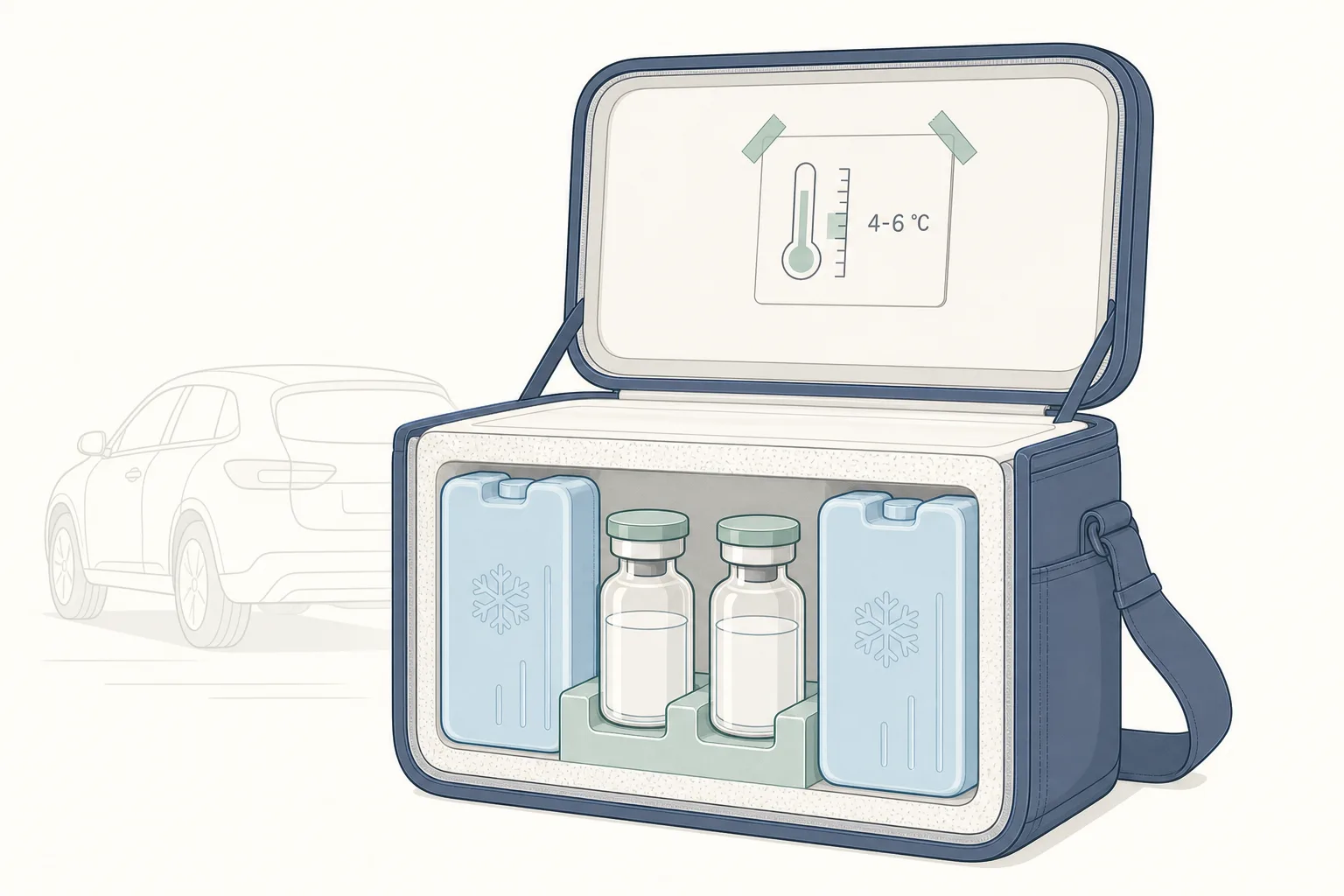
Travel and transport
- Carry-on, not checked. Cargo holds are climate-controlled on commercial flights but can dip below freezing on long-haul winter routes. Carry-on stays in the cabin temperature range. The TSA accepts insulin syringes and gel packs through screening; have the prescription label visible if challenged.
- Insulated bag + frozen gel pack. A small soft cooler with one or two gel packs frozen solid keeps a vial in range for 24+ hours. Refresh the gel packs at hotel freezers en route for longer trips.
- Hotel-fridge protocol. Most mini-bars run warmer than home fridges (8–12°C is common). Set the dial to maximum cold on arrival; check temperature with a thermometer card if you carry one. For longer stays, ask the front desk if they can swap to a normal fridge.
- Don't leave vials in cars. Parked-car temperatures swing fast and far. A summer interior can hit 50°C+ in minutes; a winter interior can dip below freezing overnight. Either failure mode is enough to ruin a vial.
- Document excursions. If the vial spent 6 hours warmer than spec, write it down - date, duration, ambient temperature. A vial log lets you decide later whether the response variance is from the excursion or from something else.
The full travel walkthrough - vial selection before the trip, customs disclosure, in-flight scheduling, time-zone-shifting fasted-window protocols - is in Peptides and Travel. The bullets above are the storage-discipline summary; that article is the operator-level extension.
What stops people
- Storing vials on the fridge door of a heavily-used fridge. The door cycles through warm air every time it opens; for a vial used daily this is fine, but for a 30-day vial in a household fridge that opens 50 times a day, the cumulative excursion adds up.
- Reusing alcohol pads. One pad, one wipe, one puncture. Saving a pad is saving 1 cent at the cost of a contamination event.
- Skipping the air-dry step. Wiping the septum and immediately puncturing pushes alcohol into the vial. Small but real contribution to peptide degradation over a multi-week vial life.
- Trusting the reconstitution date written on the cap. The cap comes off; the side of the vial is permanent. Sharpie on the side, not the cap.
- Assuming international travel preserves cold chain. Customs checks, layovers in warm terminals, lost-bag re-routing - any of these can break a 24-hour cold-pack window. Carry enough for the expected trip plus a buffer; resign yourself to discarding rather than using a vial whose chain is uncertain.
Sources
- WHO good storage and distribution practices (general pharmaceutical quality principles) - https://www.who.int/publications/i/item/9789241505454
- CDC Injection Safety (aseptic handling principles) - https://www.cdc.gov/injection-safety/hcp/resources/index.html
- USP standards overview for compounding and quality handling - https://www.usp.org/compounding