
What "reconstitution" means
Peptides ship as lyophilised (freeze-dried) powder for stability - dry, the molecule is stable for months at room temperature and years frozen. Reconstitution is the step that takes that dry stable powder and dissolves it back into a known concentration in water, ready to draw and inject. From that moment on, you're on the much shorter clock that applies to a reconstituted vial - typically 28–30 days refrigerated.
Three things have to be right at reconstitution: the diluent (which water, what volume), the dissolution (how the water meets the powder), and the bookkeeping (label, math, traceability). Each has its own failure mode.
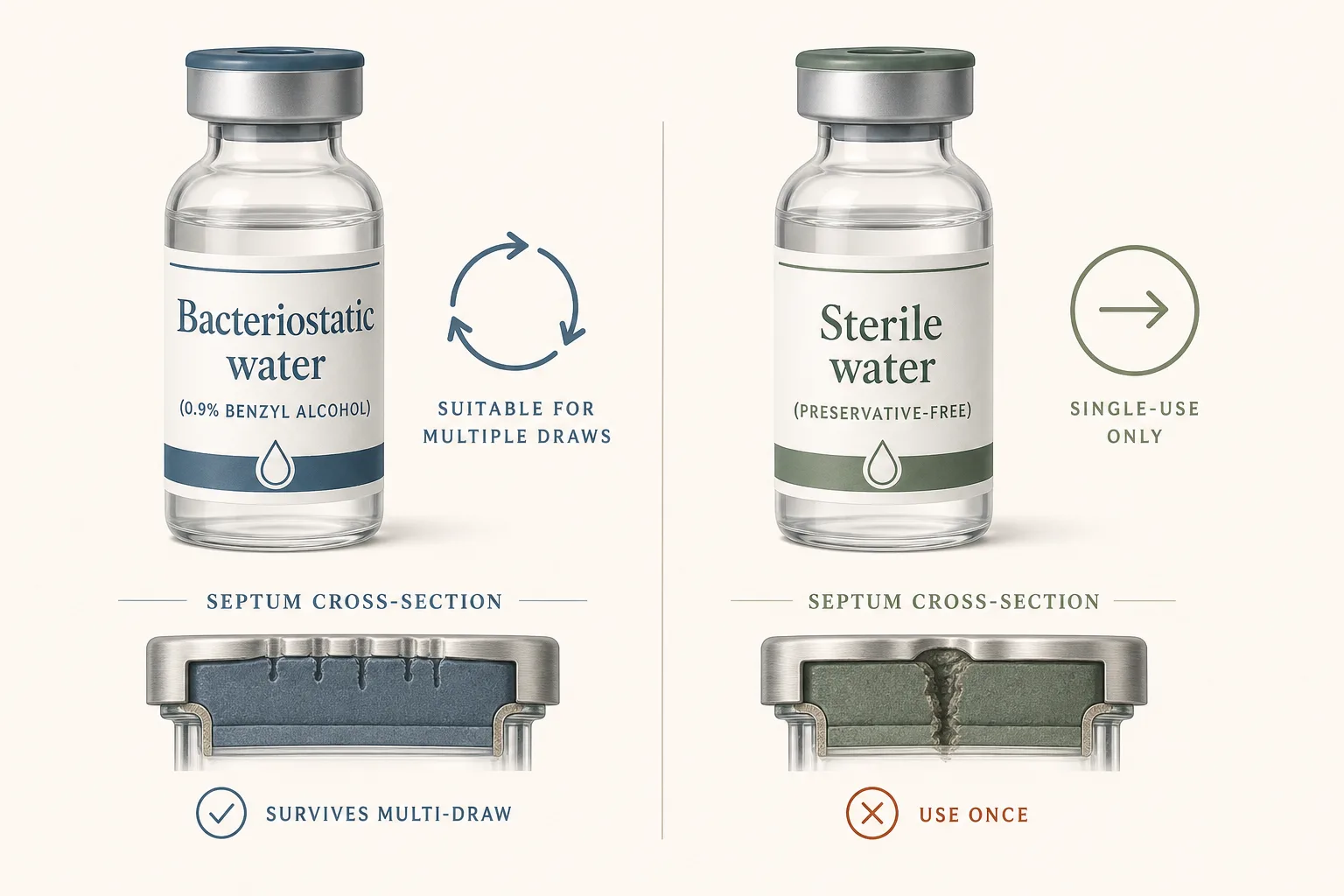
BAC water vs sterile water vs other diluents
- Bacteriostatic water (BAC water). Sterile water with 0.9% benzyl alcohol as a preservative. The benzyl alcohol inhibits bacterial growth in the multi-puncture vial - this is what buys the 28-day refrigerated window. The default diluent for nearly all multi-dose peptide reconstitution.
- Sterile water for injection (preservative-free). Single-use only. Once the seal is broken, the vial has hours, not weeks. Use only when the protocol calls for a single injection from the reconstituted vial, or when benzyl alcohol is contraindicated (rare - primarily neonatal medicine, not a body-hacker concern).
- Sodium chloride 0.9% (saline). Sometimes used for GLP-1 reconstitution where the manufacturer specifies it. Adds isotonicity but no preservative - same single-use clock as sterile water unless explicitly stabilised.
- Acetic acid solutions. Some peptides prefer acidic carriers for solubility (cagrilintide, certain analogues). Per the product monograph; not a default.
Default for the catalogue: BAC water from a US-pharmacy or compounding- pharmacy source. Avoid saline-only for catalogue peptides unless the protocol specifically calls for it.
Volume selection - the trade-off
How much BAC water you add changes the concentration, which changes the draw-volume per dose, which changes how the protocol feels at the bench:
- Lower volume (1–2 mL on a 5–10 mg vial). Higher concentration. Smaller draw per dose - less peptide left in syringe dead space and on the needle, less benzyl alcohol per injection. The cost: math has to land on whole insulin-syringe units, and small dose errors are amplified.
- Higher volume (3–5 mL on a 5–10 mg vial). Lower concentration. Larger draw per dose - finer dose granularity, less sensitive to small-volume measurement errors. The cost: more syringe-dead-space waste per dose, more total benzyl alcohol exposure over the vial life, and shorter shelf life if you go past 2 mL because the BA is diluted further.
Sweet spot for most catalogue peptides: pick a volume that puts your typical dose on whole insulin-syringe units. The Reconstitution Cheat Sheet has the at-the-bench math table.
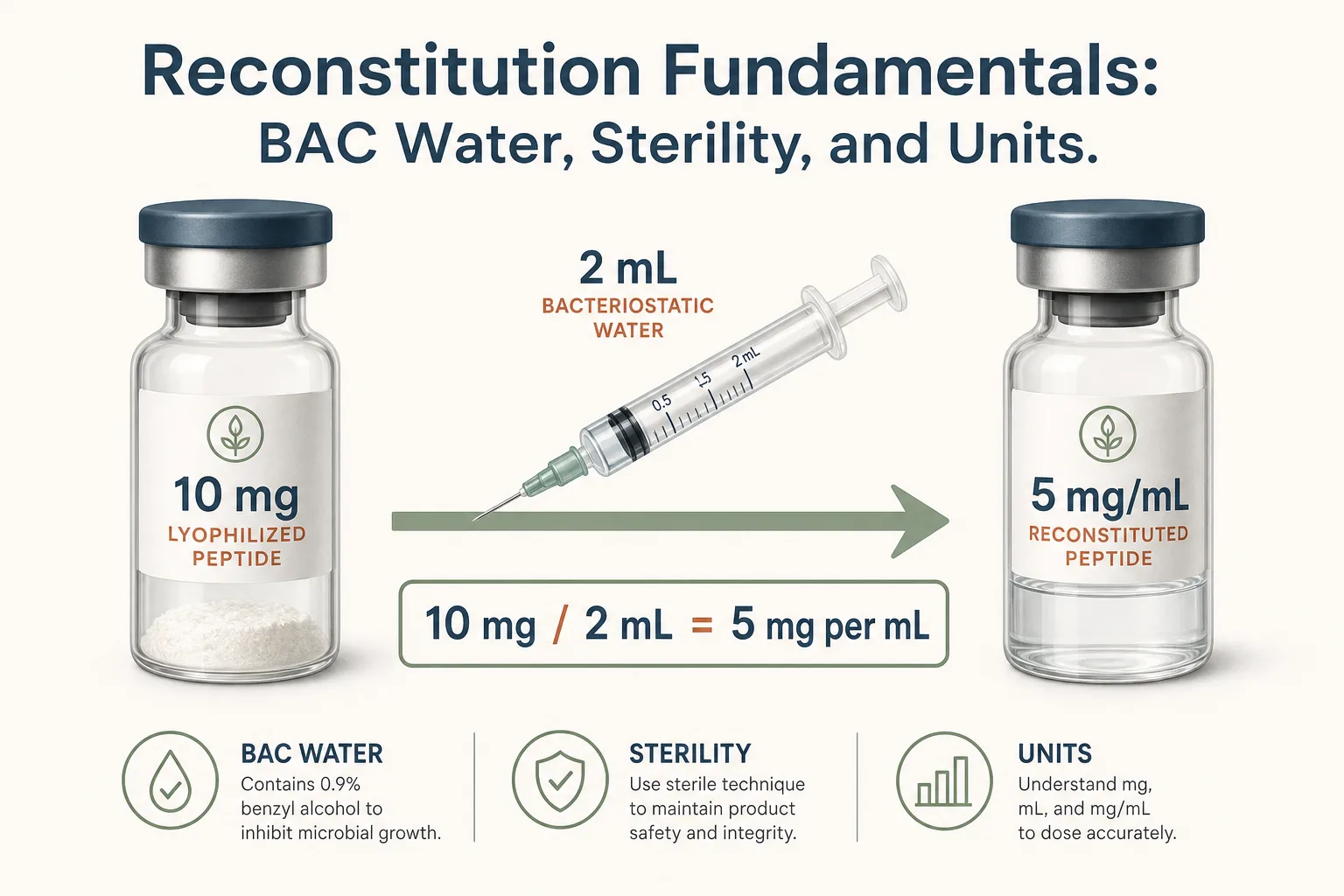
Concentration math (core formula)
Concentration (mg/mL) = total peptide amount (mg) ÷ total reconstitution volume (mL).
Example: 10 mg reconstituted with 2 mL gives 5 mg/mL = 5000 mcg/mL. On a U-100 insulin syringe (100 units = 1 mL), that's 50 mcg per unit mark. A 250 mcg dose is 5 units.
For the at-the-bench unit-mark table - common vial sizes against common BAC volumes, with insulin-syringe units pre-computed for typical doses - see Reconstitution Cheat Sheet. For multi-vial blends, per-class day-21 / day-28 activity drift, and the partial-draw problem (why late-vial draws aren't the same as day-1 draws), see Reconstitution Advanced.
Dissolution: how the water meets the powder
- Stream BAC water down the vial wall. Don't dispense directly onto the lyophilised cake. The forceful contact is the most common cause of foaming, and foaming damages peptide structure (denaturation at the air-water interface). Tilt the vial, drip the BAC water down the inner wall, let gravity pool it on top of the cake.
- Invert and gently swirl. Don't shake. Once the water is in, slow inversion and gentle swirling for 30–60 seconds dissolves the cake without generating foam. Vigorous shaking shears proteins and aggregates them.
- Let it sit if it doesn't dissolve immediately. Some peptides take several minutes at room temperature, or 5–15 minutes refrigerated, to fully dissolve. Watch for a clear solution with no visible particulates. If you see persistent particles or a haze that doesn't clear, something's wrong - degraded compound, wrong diluent, or contamination.
- Specific cases. BPC-157 reconstitutes quickly and cleanly. IGF-1 LR3 can take longer and sometimes leaves a faint haze that clears on warming briefly to room temp. GLP-1 family and PT-141 reconstitute fast. The lyo cake's appearance pre-water (uniform vs cracked vs partially collapsed) gives a hint of how it was stored before you got it.
Converting mg and mcg
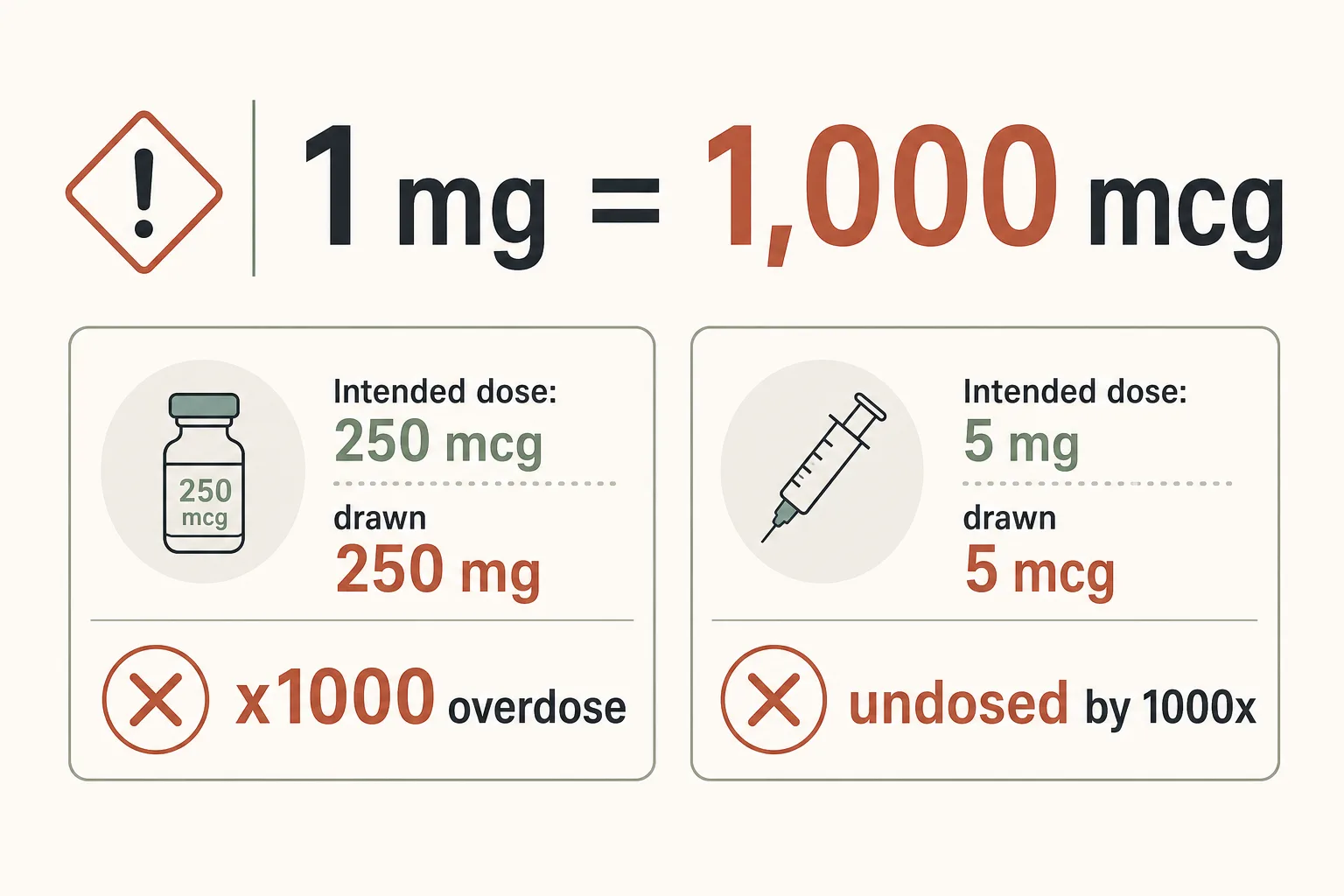
- 1 mg = 1000 mcg.
- If concentration is 5 mg/mL, that's also 5000 mcg/mL.
- For per-dose math at the syringe, see Syringe Unit Conversions.
Aseptic handling at reconstitution
The dissolved peptide is a sterile multi-puncture vial only as long as you keep it that way. The full handling protocol is in Storage and Handling Best Practices; the reconstitution-day specifics:
- Wash hands. Wipe both septa (peptide vial and BAC water vial) with 70% IPA. Let them air-dry - don't blow on them.
- Use a fresh sterile syringe to draw BAC water. Don't reuse it for the actual dose draws afterward.
- Single, clean puncture for each access. Coring (small rubber particles knocked into solution) accumulates with multiple punctures; the reconstitution puncture is the first one, treat it with care.
- Don't bottom-out the needle against the vial floor. Tip should sit in the headspace as you dispense; the wall-stream technique already points the needle at the side.
Bookkeeping
- Mark the vial. Permanent marker on the side, not the cap. Date in YYYY-MM-DD format. Concentration in your preferred unit (mcg/U or mg/mL - match how you'll draw).
- Note the source and lot. Keep the box or log it separately. If a vial fails (counterfeit, contamination, response drift), the lot ID determines scope.
- 28-day default discard. Mark a discard date 28 days forward. The cheat sheet has the per-class refinements; default to 28 days unless you have a reason to extend or shorten.
Common pitfalls
- Mixing up mg and mcg. The 1000x error is the most consequential failure in this whole workflow. Read the label twice, write the math down, draw with the same unit you wrote.
- Forgetting the actual final volume. If you added 2 mL but the lyo cake itself displaces some volume (rare but real for larger vials), the concentration is slightly different from the math. For practical purposes the displacement is negligible; just be aware that the math is "added water," not "final solution volume."
- Forcing water in too fast. Foaming kills protein. Slow stream against the wall.
- Shaking instead of inverting. Generates foam, aggregates protein. Invert and swirl.
- Reconstituting "in advance." A pre-reconstituted vial sitting in the fridge before you actually need it burns shelf life that could have been used at peak activity later in the cycle. Reconstitute when you're ready to start dosing.
- Topping up an old vial with new BAC water. Don't. The mixed-age vial confuses every shelf-life and concentration assumption. Always reconstitute fresh.
Quality-control checklist
- Label written: date, concentration, lot - on the side of the vial.
- Solution clear, no visible particulates or haze.
- No foam after dissolution complete.
- Discard date scheduled (28 days default; per-compound rules in Cold-Chain Quick Reference).
- Vial stored upright in fridge front shelf or door, not back wall.
Sources
- CDC Injection Safety (clinical safety guidance) - https://www.cdc.gov/injection-safety/hcp/clinical-safety/index.html
- DailyMed: Bacteriostatic Water for Injection (product labeling examples) - https://dailymed.nlm.nih.gov/dailymed/lookup.cfm?setid=87d6e9dc-fe3b-4593-ac9a-d7493d1959c7
- USP General Chapter <797> (sterile compounding framework) - https://www.usp.org/compounding/general-chapter-797